Blogs
Why Is My Loan Application Rejected? 10 Reasons & Solutions
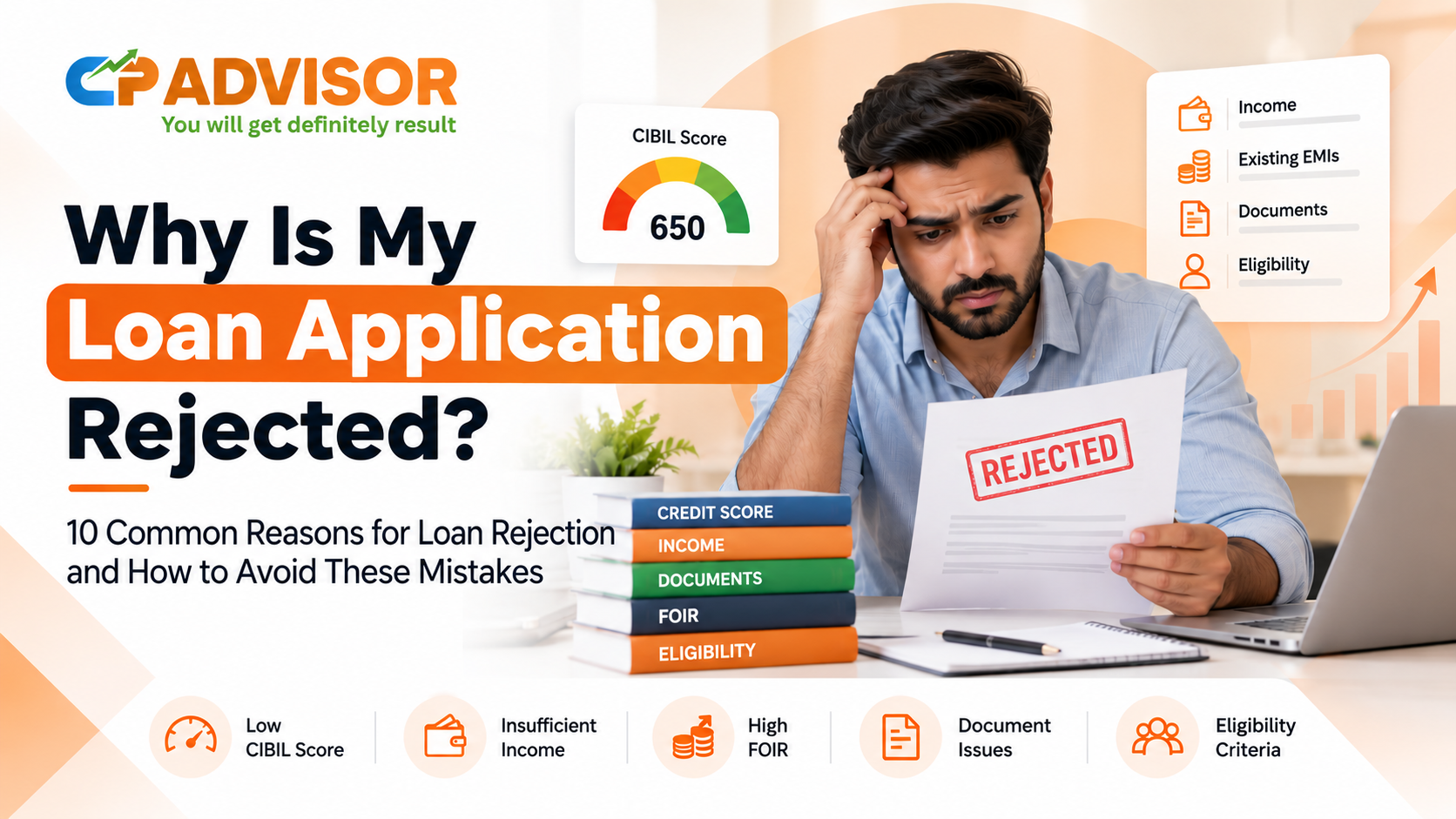
10 Common Reasons for Loan Rejection and How to Avoid These Mistakes.https://cpadvisordigital.in/free-credit-score
Have you recently applied for a personal loan or business loan and received a rejection? A loan rejection can be frustrating, especially when you need funds for an important expense or business requirement. However, a rejected application does not necessarily mean you can never qualify for a loan.
Banks and Non-Banking Financial Companies (NBFCs) evaluate several factors before approving a loan, including your credit history, income, existing financial obligations, employment or business profile, documentation, and eligibility criteria.
Understanding why your loan application was rejected can help you identify potential issues and prepare more effectively before applying again.
In this guide, CP Advisor explains the 10 most common reasons for loan rejection, practical steps to address them, and what you should do before submitting your next application.
1. Low CIBIL Score or Poor Credit History
Your CIBIL or other credit bureau score is one of the factors lenders may consider when evaluating your loan application. A low credit score, missed EMI payments, overdue credit card bills, or previous defaults may affect your chances of approval.
However, credit score requirements vary between lenders and loan products. Even applicants with a good credit score may face rejection for other reasons.
How to improve your credit profile:
Check your credit report for incorrect entries or unfamiliar accounts.
Pay your existing loan EMIs and credit card bills on time.
Clear overdue payments where financially possible.
Keep your credit card balances under control.
Avoid submitting multiple loan applications without checking eligibility.
Reviewing your credit report regularly can help you identify issues that may need attention before your next application.

2. Insufficient Monthly Income
Lenders assess whether your income is sufficient to manage the proposed EMI along with your existing financial commitments.
If your monthly salary or business income falls below the lender's minimum requirement, your loan application may be rejected. Your income stability and repayment capacity may also influence the decision.
How to improve your chances:
Check the lender's minimum monthly income criteria.
Choose a loan amount that matches your repayment capacity.
Maintain accurate salary slips, bank statements, or business income records.
Ensure your declared income is consistent with your supporting documents.
Before applying, estimate whether the proposed EMI fits comfortably within your monthly budget.
3. High Existing EMIs or FOIR
Having several active loans or high monthly financial obligations can reduce your chances of getting a new loan approved.
Lenders may use FOIR (Fixed Obligations to Income Ratio) to assess how much of your monthly income is already committed to existing obligations. A higher FOIR may indicate limited capacity to take on additional repayments.
For example, if a large portion of your monthly income goes toward existing EMIs, a lender may determine that an additional loan would put pressure on your finances.
How to manage your FOIR:
Review your existing loan EMIs and other fixed obligations.
Avoid taking on additional debt if your budget is already stretched.
Consider reducing outstanding obligations where feasible.
Estimate the impact of the proposed EMI on your monthly finances.
Calculate your FOIR before applying:
https://cpadvisordigital.in/foir-calculator
Using the CP Advisor FOIR Calculator can help you understand your existing financial commitments and assess your readiness for another loan. The calculation is an estimate and does not guarantee approval.
4. Incomplete or Incorrect Documents
Documentation errors are another common reason a loan application may be delayed or rejected.
Missing salary slips, incomplete bank statements, incorrect bank details, mismatched personal information, or discrepancies between your application and supporting documents can create verification issues.
How to avoid documentation-related rejection:
Provide accurate personal, employment, and income information.
Submit all documents requested by the lender.
Check that your name, address, date of birth, and other details are consistent.
Ensure uploaded documents are clear, valid, and readable.
Respond promptly to requests for additional information.
Reviewing your application carefully before submission can help reduce avoidable errors.
5. Unstable Employment or Inconsistent Business Income
Lenders may evaluate your employment stability, length of service, business vintage, income consistency, and banking activity when assessing your repayment capacity.
Frequent job changes, irregular salary credits, inconsistent business cash flow, or insufficient business operating history may affect eligibility, depending on the loan product and lender's policy.
What you can do:
Maintain accurate records of your salary or business income.
Keep relevant bank statements and employment documents ready.
Maintain business registration and financial records where applicable.
Ensure that your income details are properly supported by documentation.
If you are self-employed, review the lender's requirements for business vintage, turnover, banking activity, and income tax returns before applying.
6. Applying for a Loan Amount That Is Too High
You may meet a lender's basic eligibility criteria but still be declined for the amount you requested.
The lender may determine that the proposed EMI is too high relative to your income, existing liabilities, or repayment capacity.
How to improve your chances:
Estimate an affordable monthly EMI.
Compare different loan amounts and repayment tenures.
Consider requesting a lower amount if it better matches your financial position.
Review the lender's eligibility criteria before applying.
Remember that a lower requested amount does not automatically guarantee approval. The lender will assess your complete financial profile before making a decision.
7. Multiple Recent Loan Applications
Applying for several loans within a short period may result in multiple credit enquiries. Depending on your credit profile and the circumstances, these enquiries may influence how lenders assess your application.
Frequent applications may also indicate that you are actively seeking additional credit, although lenders consider multiple factors when evaluating risk.
What you should do:
Understand the reason for your previous loan rejection.
Compare loan products and eligibility criteria before applying.
Use available eligibility-checking tools where appropriate.
Submit applications selectively rather than applying indiscriminately.
Taking time to review your financial profile can help you make more informed borrowing decisions.
8. Issues in Your Bank Statements
Bank statements help lenders understand your income, spending patterns, existing obligations, and overall financial activity.
Frequent cheque returns, missed EMI payments, irregular salary credits, unexplained transactions, or insufficient funds may raise concerns during the assessment process.
For self-employed applicants, inconsistent business transactions or limited evidence of regular cash flow may also affect eligibility.
How to prepare your bank statements:
Maintain sufficient funds for scheduled repayments.
Avoid missed EMI and cheque payments.
Keep salary credits and business transactions properly documented.
Ensure the bank statements submitted cover the period requested by the lender.
Be prepared to explain legitimate transactions if additional information is requested.
There is no single bank statement pattern that guarantees approval. Each lender applies its own assessment criteria.
9. Not Meeting the Lender's Eligibility Criteria
Every bank and NBFC has its own eligibility requirements. These may include:
Minimum and maximum applicant age.
Minimum monthly income.
Credit score or credit history requirements.
Employment type and work experience.
Business vintage and financial performance.
Residential location or serviceable PIN code.
Existing loan obligations and repayment history.
You might qualify for one loan product but not another because the eligibility criteria differ.
How to improve your chances:
Check the lender's current eligibility requirements.
Compare loan products that match your income and employment profile.
Verify whether your location is serviceable.
Prepare the documents required for your applicant category.
Apply only when you have a reasonable understanding of the product's requirements.
CP Advisor helps customers explore loan options and understand the application process. Final eligibility and approval decisions are made by the respective lending institution.
10. Errors or Mismatches During KYC Verification
Know Your Customer (KYC) verification allows lenders to verify your identity and other required information.
Incorrect personal details, expired or unclear documents, mismatched records, or incomplete verification may prevent an application from progressing.
How to avoid KYC-related issues:
Submit valid and legible identity and address documents.
Verify your personal information before submitting the application.
Ensure that the information in your application matches your supporting records.
Complete any additional verification requested by the lender through its authorized process.
Accurate information and complete documentation can help make the verification process smoother, although approval remains subject to the lender's assessment.
What Should You Do After Your Loan Application Is Rejected?
If your personal loan or business loan application has been rejected, avoid immediately applying to several other lenders without understanding what happened.
Instead, follow these steps.
Step 1: Understand the Reason for Rejection
Review the lender's communication and ask for clarification if the reason is not clear. Identifying the underlying issue will help you determine what needs attention.
Step 2: Check Your Credit Report
Review your credit history for overdue accounts, incorrect entries, or unfamiliar credit enquiries. Raise a dispute with the relevant credit bureau or lender if you find an error.
Step 3: Review Your Income and Existing EMIs
Assess your monthly income, current obligations, and the additional EMI you are considering. A high debt burden may require you to reconsider the loan amount or timing.
Step 4: Correct Documentation Errors
Check your application details, bank statements, income proofs, and KYC documents. Correct any discrepancies before submitting another application.
Step 5: Compare Lender Eligibility Criteria
Different lenders may have different requirements for income, credit history, employment, business vintage, and location. Compare the criteria carefully instead of assuming every lender will assess your application in the same way.
Step 6: Apply Again When Appropriate
Consider submitting another application after addressing the relevant issues and reviewing the lender's requirements. There is no universal waiting period that guarantees approval after rejection.
Can My Loan Be Approved After Rejection?
Yes, a future loan application may be approved if the issues affecting the earlier application are resolved and you meet the new lender's eligibility requirements.
For example, correcting an error in your credit report, providing missing documents, reducing existing financial obligations, or choosing a more suitable loan amount may help improve your application.
However, these steps do not guarantee approval. Each lender makes its own decision after assessing your complete financial profile, the requested loan product, and its applicable policies.
How Can CP Advisor Help You Explore Loan Options?
Choosing a suitable loan starts with understanding your financial position and the eligibility requirements of different lenders.
CP Advisor provides a platform to help customers explore loan options and understand the application process.
Before applying for your next loan, consider these three steps:
Review your financial profile: Check your credit history, income, and existing obligations.
Calculate your FOIR: Understand how much of your income is committed to existing financial obligations.
Explore suitable loan options: Review the relevant lender's eligibility criteria and documentation requirements.
Calculate Your FOIR Before Applying
Use the CP Advisor FOIR Calculator to estimate your Fixed Obligations to Income Ratio and better understand your monthly financial commitments.
Visit the CP Advisor website to explore available loan-related services and information:
CP Advisor — Understand Your Eligibility. Explore Your Options. Apply Smart.
Frequently Asked Questions About Loan Rejection
1. Why is my personal loan rejected even with a good CIBIL score?
A good CIBIL score does not guarantee loan approval. Lenders may also consider monthly income, existing EMIs, FOIR, employment stability, bank statements, documentation, and internal eligibility criteria.
2. Can I apply for a loan again after rejection?
Yes, you may apply again, but it is advisable to understand the reason for the rejection first. Address any relevant issues and check the new lender's eligibility criteria before submitting another application.
3. Does loan rejection affect my CIBIL score?
Loan rejection itself is generally not recorded as a separate negative event in your credit score. However, a credit enquiry associated with your application may affect your score, depending on the circumstances.
4. Can I get a business loan without an ITR?
Some lenders require income tax returns, while others may accept alternative financial documents for certain products or applicant categories. Requirements vary by lender, and approval depends on the overall assessment.
5. Does checking FOIR guarantee loan approval?
No. FOIR is one factor used to understand financial obligations relative to income. Lenders may also assess credit history, income stability, documents, employment or business profile, and other eligibility requirements.
6. How long should I wait before applying again after loan rejection?
There is no universal waiting period for every loan application. The appropriate timing depends on the reason for rejection, whether the issue has been resolved, the lender's policy, and the type of loan.
7. Can I get a personal loan with a low CIBIL score?
Some lenders may consider applicants with different credit profiles, but eligibility depends on their policies and the applicant's overall financial circumstances. A lower credit score may limit available options or affect the terms offered.
Final Thoughts
A rejected loan application can be disappointing, but it can also be an opportunity to review your financial profile before borrowing again.
Low credit scores, insufficient income, high FOIR, documentation errors, inconsistent income, and lender-specific eligibility requirements are among the factors that may contribute to loan rejection.
Before applying again, take time to understand the reason for the decision, review your credit report, calculate your existing financial obligations, and check the lender's requirements.
Start with your financial readiness, compare suitable options, and make informed borrowing decisions with CP Advisor.
Disclaimer: This article is for general educational and informational purposes only and does not constitute financial advice or a guarantee of loan eligibility or approval. Loan eligibility, interest rates, documentation requirements, and approval decisions vary by lender and loan product. CP Advisor does not guarantee loan approval. Applicants should review the applicable terms and conditions before proceeding.